
First publication on FDCA bis-cyclic carbonate from the D-carbonize project
First publication on FDCA bis-cyclic carbonate from the D-carbonize project
We are pleased to announce the publication of the first article by Giovanni Berluti, PhD student within the D-carbonize project. The paper is now available in Green Chemistry (Royal Society of Chemistry) and focuses on the development of a new synthetic route to bio-based FDCA bis-cyclic carbonate.
This study was carried out during the first part of Giovanni’s PhD at the University of Groningen (Netherlands), under the supervision of Paolo Pescarmona. It explores the valorisation of 2,5-furandicarboxylic acid (FDCA), widely recognised as a promising bio-based platform molecule. Despite its strong potential, its industrial application has long been limited due to high production costs. However, with the recent scale-up of FDCA production, new opportunities are emerging for the development of bio-based chemicals derived from this compound.
The study addresses the valorisation of 2,5-furandicarboxylic acid (FDCA), widely recognised as a promising renewable platform molecule. Despite its strong potential, the industrial use of FDCA has historically been limited. With the recent scale-up of FDCA production, new opportunities are emerging for the development of advanced bio-based chemicals such as the FDCA bis-cyclic carbonate.
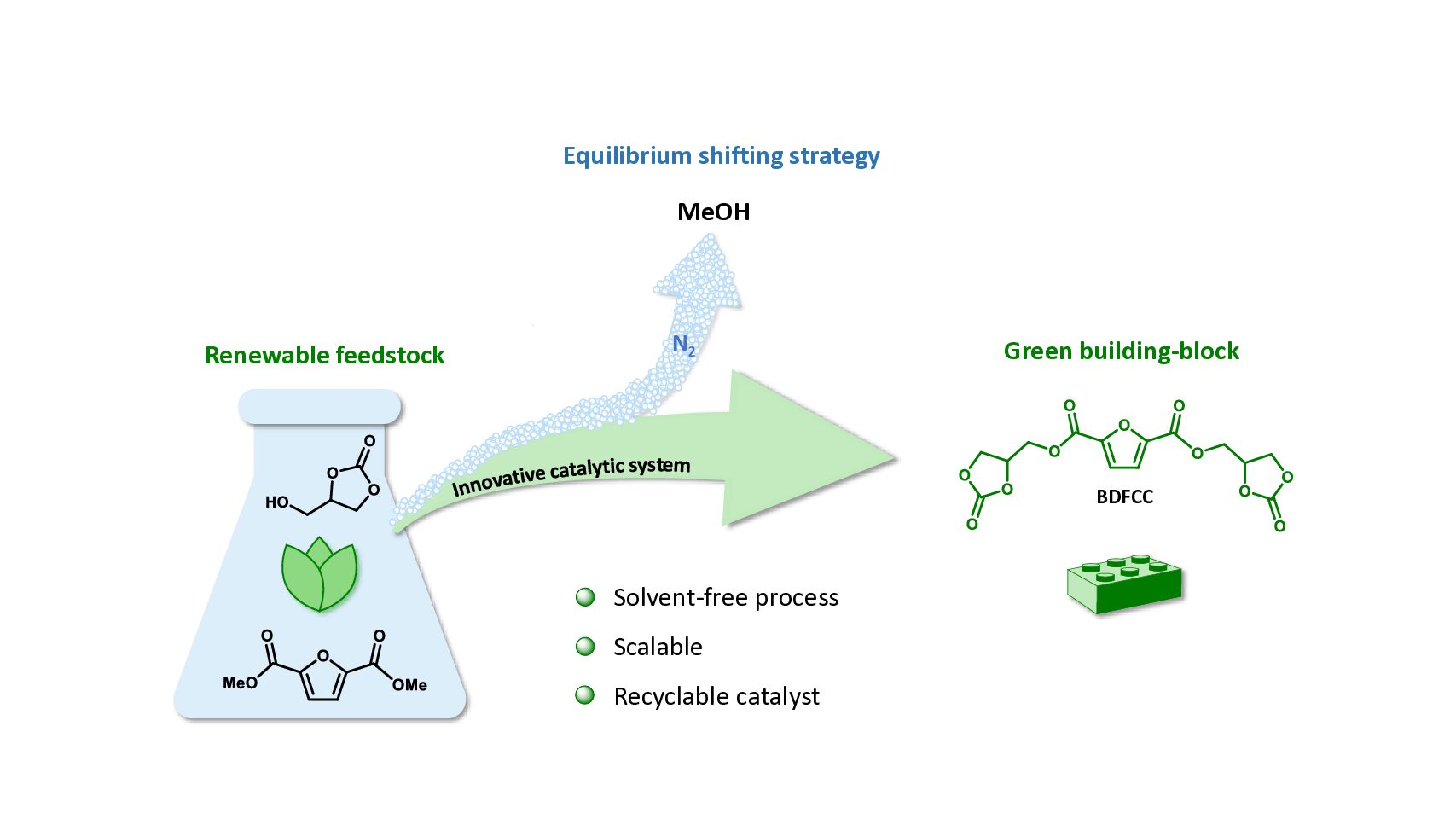
In this work, the authors report the synthesis of an FDCA bis-cyclic carbonate from renewable feedstocks using an innovative catalytic approach. Featuring two cyclic carbonate functionalities, the resulting molecule serves as a valuable intermediate for the design of sustainable polymers. It also shows strong potential to replace hazardous CMR substances currently used in polyurethane and polycarbonate production, contributing to the development of safer and more sustainable materials.
The study highlights several key contributions, including the development of a novel catalytic route, a thermodynamic analysis of the reaction system, the optimisation of solvent-free conditions for FDCA bis-cyclic carbonate formation, and a preliminary assessment of the process scalability. Overall, this collaborative research demonstrates an important step forward in the transformation of renewable building blocks into high-value polymer precursors.
This publication marks a key milestone for the D-carbonize project and strengthens ongoing efforts to advance the next generation of sustainable chemistry solutions.
📖 If you are interested in this work, the publication is available open-access here.